
I should have reviewed this earlier, but I kind of forgot to. Anyway....
This script is excellent at achieving what it was meant to, and it's ridiculously easy to set-up.
Another reason why I like this script quite a bit is just how useful it is if you apply a bit of "out of the box" thinking.
Not sure what else to add though, it's pretty straightforward what this thing is and what it's good for. I like it, and I'll probably find a use for it in every quest I'm making from here on out.
Reverse Patra

Overview
Creator:
Lejes
Updated: 29 Aug 2015
Tags:
Enemy,
FFC
Downloads: 75
|
View Script
Download Example (867.05 KB) |
Information
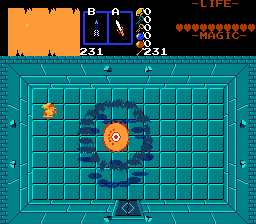
A Patra-like enemy whose core must be destroyed first. Comes with adjustable parameters.
Description Setup Reviews Comments
Requires std.zh. Attach the script to an FFC in a room with the core enemy. Placing orbiters is unnecessary, as the script creates them itself.
D0 is the room index number of the core enemy.
D1 is the enemy ID of the orbiter and number of orbiters combined into one argument. Left of the decimal: Enemy ID of orbiter. Right of the decimal: Number of orbiters. 40.0016 would cause 16 Keese to orbit, for example. More than 100 orbiters will break things.
D2 is the rotation speed of the orbiters. Use negative values for counter-clockwise rotation.
D3 is the distance between the core enemy and the orbiters, in pixels.
D4 is the expansion interval, in frames. 60 frames is equal to 1 second. The orbiters will fly out to 2.5 times their original radius three times. Use 0 for no expansion.
D5 = Number to the left of the decimal is 2 if orbiters block weapons, 1 if they ignore them, 0 if they keep their old resistances.
Number to the right of the decimal is 0001 if all orbiters die along with core enemy, 0000 if they're set free instead.
D6 is the X offset of the orbiters' center of rotation. 0 is recommended for 16x16 (one tile) enemies, and 8 for 32x32 (2x2 tile) big enemies.
D7 is the Y offset of the orbiters' center of rotation. 0 is recommended for 16x16 (one tile) enemies, and 8 for 32x32 (2x2 tile) big enemies.
D0 is the room index number of the core enemy.
D1 is the enemy ID of the orbiter and number of orbiters combined into one argument. Left of the decimal: Enemy ID of orbiter. Right of the decimal: Number of orbiters. 40.0016 would cause 16 Keese to orbit, for example. More than 100 orbiters will break things.
D2 is the rotation speed of the orbiters. Use negative values for counter-clockwise rotation.
D3 is the distance between the core enemy and the orbiters, in pixels.
D4 is the expansion interval, in frames. 60 frames is equal to 1 second. The orbiters will fly out to 2.5 times their original radius three times. Use 0 for no expansion.
D5 = Number to the left of the decimal is 2 if orbiters block weapons, 1 if they ignore them, 0 if they keep their old resistances.
Number to the right of the decimal is 0001 if all orbiters die along with core enemy, 0000 if they're set free instead.
D6 is the X offset of the orbiters' center of rotation. 0 is recommended for 16x16 (one tile) enemies, and 8 for 32x32 (2x2 tile) big enemies.
D7 is the Y offset of the orbiters' center of rotation. 0 is recommended for 16x16 (one tile) enemies, and 8 for 32x32 (2x2 tile) big enemies.